Monday, January 13, 2014

Revolver


"It was in April 1966 that we started recording Revolver."-George Harrison

After releasing Rubber Soul in 1965 and releasing Yesterday and Today in the US The Beatles started recording their seventh LP, Revolver. It was 6 April, 1966 when the recording for the album started and lasted till 21 June, 1966. The full album, including fourteen original tracks lasted around 34 minutes and 40 seconds.

Producer: George Martin
Engineers: Geoff Emerick and Peter Vince
Released: 5 August 1966 (UK)
                8 August 1966 (US)
John Lennon: Vocals, harmonium, electric guitar, acoustic guitar, tape loops, tambourine, handclaps, finger clicks
Paul McCartney: Vocals, bass, piano, acoustic guitar, electric guitar, clavichord, tape loops, handclaps, finger clicks
George Harrison: Vocals, acoustic guitar, electric guitar, bass, sitar, tape loops, tambourine, maracas, tambura, handclaps, finger clicks
Ringo Starr: Vocals, drums, tambourine, maracas, tape loops, cowbell, shaker, handclaps, finger clicks
George Martin: piano, organ, backing vocals

The album was the last album the group would release while still touring, after 29 August 1966 (when The Beatles played Candlestick Park- their last concert until the Rooftop).  This album was an opening to new experimental songwriting and defiantly different from what the mop-topped, suited boys have previously done. As John Lennon said,
"One thing's for sure - the next LP is going to be very different."
Revolver is often referred to as 'the acid album'. In the previous year (1965) John and George had accidentally taken acid that was slipped into their drinks while attending a party with their dentist. This trip is often known as "The Dental Experience". LSD was given to John and Cynthia Lennon, George Harrison, and Pattie Boyd, none of them had ever had experience with this wondrous drug and didn't take their dentist's advice when he told them to stay until the drug wore off. The four left in George's mini cooper and headed to a night club.

"We'd just sat down and ordered our drinks when suddenly I felt the most incredible feeling come over me. It was something like a very concentrated version of the best feeling I'd ever had in my whole life. It was Fantastic. I felt in love, not with anything or anybody in particular, but with everything."- George Harrison
"It was terrifying but it was fantastic."- John Lennon
 Ringo took it shortly after John and George, it took Paul two years to come around and try it. The drug become an influence to some of The Beatles songs during these sessions, for instance "She Said, She Said" was written off of a John Lennon acid experience with actor Peter Fonda.

Another break through happened during the recording of Revolver. EMI engineer Ken Townsend in April of 1966 invented ADT (Artificial Double Tracking), when you link two tape machines and creates a doubled vocal track. This technique was used profoundly with The Beatles and later became big in pop productions. The group were ecstatic when this was created, George even telling Ken that he should of received a medal for inventing it. George Martin tried explaining how the process works to John saying the following,
"I knew he'd never understand it, so I said 'Now listen, it's very simple. We take the original image and we split it through a double vibrocated sploshing flange with double negative feedback...' He said 'You're pulling my leg. Aren't you?' I replied 'Well, let's flange it again and see'. From that moment on, whenever he wanted ADT he would ask for his voice to be flanged, or call out for 'Ken's flanger.'"
Rubber Soul was when The Beatles really started experimenting with new things, for example George Harrison with the sitar. Soon they were using ADT in Revolver and also playing songs backwards.
"Revolver very rapidly became the album where the Beatles would say 'OK, that sounds great, now let's play it backwards or speeded up or slowed down'. They tried everything backwards, just to see what things sounded like. "- Geoff Emerick
The group first started with backward songs on off- Revolver song, "Rain" which were recorded on 14 April 1966. This resulted in two songs from the LP to be feuatre backwards recordings; "I'm Only Sleeping" and "Tomorrow Never Knows"

Track-List;
  1.  Taxman (Harrison)
  2. Eleanor Rigby (Lennon-McCartney)
  3. I'm Only Sleeping (Lennon-McCartney)
  4. Love You To (Harrison)
  5. Here, There and Everywhere (Lennon-McCartney)
  6. Yellow Submarine (Lennon-McCartney)
  7. She Said She Said (Lennon-McCartney)
  8. Good Day Sunshine (Lennon-McCartney)
  9.  And Your Bird Can Sing (Lennon-McCartney)
  10. For No One (Lennon-McCartney)
  11. Doctor Robert (Lennon-McCartney)
  12. I Want To Tell You (Harrison)
  13. Got To Get You Into My Life (Lennon-McCartney)
  14. Tomorrow Never Knows (Lennon-McCartney)
Taxman
 The album starts off with the countdown one-two-three-four and leads into "Taxman", a song written by George Harrison about how much money they were loosing to the 'taxman' and were all fed up about it.
"I discovered I was paying a huge amount of money to the taxman. You are so happy that you've finally started earning money - and then you find out about tax."- George Harrison
Paul McCartney even says the song is "Very George". When the group had business meetings and the accountants would explain to them about tax George would be the one to speak up and question why their money was being taken.  Ringo says that they were all pissed off at the taxation and that they even went in with a plan having a guy go to the Bahamas and hold their money so it would be tax-free but didn't work out in the end.
"'Taxman' was an anti-Establishment tax song, where we said, 'If you walk the streets, they'll tax your feet.' George wrote it and I helped him with it. At the time we weren't aware of the whole tax scene. I'm still not really aware of what goes on with taxes. We believe that if you earn it, you may as well keep it, unless there's a communal or Communist or real Christian society. But while we're living in this, I protest against paying the government what I have to pay them."- John Lennon
Eleanor Rigby
" I wrote 'Eleanor Rigby' when i was living in London and had a piano in the basement.  I used to disappear there and have a fiddle around, and while I was fiddling on a chord some words came out; 'Dazzie-de-da-zu picks up the rice after a wedding took it in the poignant direction, into a 'lonely people' direction.'"- Paul McCartney
There's many different stories about how the name "Eleanor Rigby" came to be. Paul says he got Eleanor from Eleanor Bron, the actress in there second movie "Help!" and "Rigby" was from a store in Bristol. It turns out that at St. Peter's Church in Woolton- Paul and John met across the street from the church in the church hall read about it here. In St Peter's cemetery there is a grave stone a few rows back and about three or so heads in lies the Rigby family. Eleanor Rigby (married to Thomas Woods) is burried a few rows behind the Mackenzie family where the name 'Father Mackenzie' came.
"'Eleanor Rigby' was Paul's baby, and I helped with the education of the child."- John Lennon
I'm Only Sleeping
  "He can sleep almost indefinitely, is probably the laziest person in England."-Maureen Cleave.
One of the two songs on Revolver that features the backwards guitar which gives it a 'yawning' effect.

Love You To
One of the songs written and influenced by George's new interest in Indian music.
"I wrote 'Love You To' on sitar, because the sitar sounded so nice and my interest was getting deeper all the time. I wanted to write a tune that was specifically for the sitar. Also it had a tabla part, and that was the first time we used a tabla player."- George Harrison
The Beatles were first introduced to the sitar in the film "Help!" and George's interest kept growing, that's when The Beatles met Ravi Shankar who as Paul said George was 'knocked out by him'.
"The Indian sounds are definitely mainly George."- Paul McCartney

Here, There And Everywhere
"'Here, There and Everywhere' was Paul's song completely, I believe - and one of my favourite songs of The Beatles."- John Lennon
Yellow Submarine
 A song written by both Lennon and McCartney (with help from Donovan), a children's song in which Ringo sings vocals.
"I remember lying in bed one night, in that moment before you're falling asleep - that little twilight moment when a silly idea comes into your head - and thinking of  'Yellow Submarine \' ; 'We all live in a yellow submarine...'" -Paul McCartney
 "I don't actually know where they got the idea for it, I just felt it was a really interesting track for me to do. I'd been doing a lot of covers. At The time I did either covers or something they wrote specifically for me."- Ringo Starr
Ringo also says that during this time it was hard to come out with an original song and when he did come up with an original song they'd find out it was just a re-written, lyric changed Jerry Lee Lewis or an older standard which become a little joke amongst the group.
 

She Said She Said
"She Said She Said" was mine. It's an interesting track. The guitars are great on it. that was written after an acid trip in LA during a break in The Beatles' tour where we were having fun with The Byrds and lots of girls. "- John Lennon
 The song was written while talking with Peter Fonda where he said "I know what it's like to be dead." It stuck in John's mind but he thought it didn't sound right, so it become "She Said".

Good Day Sunshine
"'Good Day Sunshine' is Paul's. Maybe I threw a line in or something - I don't know."- John Lennon
It was Paul's effort to write a "the same traditional, almost trad-jazz feel".

 And Your Bird Can Sing

A song that John said could of been a 'throwaway'.

For No One 
Another one of John's favorites written by Paul.
"On 'For No One', the track was laid down on my own clavichord. I brought it in from my home, because I thought it had a nice sound, it was a very strange instrument to record, and Paul played it. But we wanted a very special sound, and French horn was what we chose.
Paul didn't realise how brilliantly Alan Civil was doing. we got the definitive performance, and Paul said, 'Well, OK, I think you can do it better than that, can't you, Alan?' Alan nearly exploded. Of course, he didn't do it better than that, and the way we'd already heard it was the way you hear it now."- George Martin
 The song was written while in Switzerland skiing, Paul remembers writing bass-line trick and the character it was written about, a girl putting on makeup.

Doctor Robert
"'Doctor Robert' is like a joke. There's some fellow in New York, and in the States we'd hear people say, 'You can get everything you want off him - any pills you want.' it was a big racket, but a joke too about this fellow who cured everyone of everything with all these pills and tranquillizers, injections for this and that. He just kept New York high. That's what 'Doctor Robert' is all about, just a pill doctor who sees you all right. It was a joke between ourselves, but they go in in-jokes and come out out-jokes, because everyone listens and puts their own things on it, which is great. I mean when I was young I never knew what 'gilly gilly osten feffer catsa nell a bogen' was all about, but I still enjoyed signing it."- Paul McCartney
I Want To Tell You
"'I Want To Tell You' is about the avalanche of thoughts that are so hard to write down or say or transmit."- George Harrison
George once said that if he could rewrite the bridge he would of wrote "Although I seem to act unkind/It isn't me - it's just my mind. That is confusing things." instead of "But if I seem to act unkind It's only me, it's not my mind That is confusing things"


Got To Get You Into My Life
A song most people think is a love song about telling someone that you need them every single day of you life but the song is actually written about marijuana.
"'Got To Get You Into My Life' was Paul's again. I think that was one of his best song, too, because the lyrics are good - and I didn't write them. When I say that he could write lyrics if he took the effort, here's an example."- John Lennon
Tomorrow Never Knows
 The last track of the album shows how much The Beatles has changed throughout the years from "She Loves You" a pop song to a psychedelic song like "Tomorrow Never Knows". A song that can easily be identified as an acid song.
"The expression 'tomorrow never knows' was another of Ringo's. I gave it a throwaway title because I was a bit self-conscious about the lyrics. So I took one of Ringo's malapropisms, which was like 'a hard days night', to take the edge off the heavy philosophical lyrics."-John Lennon
Not only is the song psychedelic with the range of instruments and deep, unexplainable lyrics but by this time got hold of Timothy Leary's adaptation of The Tibetan Book of The Dead and was singing lines from the book in the song. Lines like "Lay down all thought, surrender to the void,' where taken from the book.
"You can hear (and I am sure most Beatles fans have) 'Tomorrow Never Knows' a lot and not know really what it is about. Basically it is saying waht meditation is all about. the goal of meditation is to go beyond ( that is, transcend) walking, sleeping, and dreaming. So the song starts out by saying, 'Turn off you mind, relax and float downstream, it is not dying'.
Timothy Leary
Then it says,' Lay down all thoughts, surrender to the void - it is shining. That you may see the meaning of within - it is being.' From birth to death all we ever do is think: we have one thought, we have another thought, another thought, another thought. Even when you are asleep you are having dreams, so there is never a time from birth to death when the mind isn't always active with thoughts. But you can turn off you mind, and go to the part which Maharishi described as: 'Where was your last thought before you thought it?'"- George Harrison
George later goes on to say that the song is them, that we are the song and it's about us being, living, breathing, thinking, to be aware from the state of being. It about transcending.

"Tomorrow Never Knows" is a definite John song who probably didn't even know half of what he was saying but knew he was writing something and going in the right direction. It's an under rated song and is usually portrayed as one of the 'weird' Beatles songs, but it's truly a song that has deeper meaning that just goes over a lot of people minds and some people aren't willing to understand the song.

The song was written in various places, John had the lyrics and each Beatle (including John) had tape recorders at home and when they were home were suppose to record their own loop.

"'Tomorrow Never Knows' was a great innovation John wanted a very spooky kind of track, a very ethereal sound. When we constructed the original version of the tape, we started off with just the tamboura drone and Ringo's very characteristic drumming."- George Martin
 Then another unique feature in this song was created by Paul McCartney messing around with his tape recorder at home. He took the erase-head off and putting on the loop it created a weird sound that saturated the tape which was later shown to the others and were used throughout the track.

Cover
Klaus Voorman with Revolver
For most of their previous albums The Beatles had Robert Freeman to photograph them but for this album the artwork was done by Hamburg friend,musician, and artist,  Klaus Voorman
"We liked the way there were little things coming out of people's ears, and how he'd collaged things on a small scale while the drawings were on a big scale. He also knew us well enough to capture us rather beautifully in the drawings. We were flattered."- Paul McCartney

Wednesday, January 1, 2014

The Beatles Decca Audtion

 "I hope he kicks himself to death!" -John Lennon


New Years Eve 1961 The Beatles; featuring John Lennon, Paul McCartney, George Harrison, and Pete Best, and their road manager and friend Neil Aspinall were driving from Liverpool to London (getting lost in the midlands) in hopes to pass an audition with Decca records on the following day (1 January, 1962).


"Brian put in a lot of time getting us off the ground. He believed in us from the start."- George Harrison

The idea of the audition came across when Beatles manager, Brian Epstein met with Mike Smith, from Decca, who had seen The Beatles preform at The Cavern Club on 13 December, 1961.

"...We were all excited: it was Decca. He'd met this Mike Smith guy and we were to go down there. So we went down and we did all these numbers; terrified and nervous, you can heart it...we virtually recorded our Cavern stage show, with a few omissions- around twenty songs."- John Lennon
The Beatles arrived for their first time in London on New Years Day and headed to Decca studios where they set up their amps and started recording their demo. The group preformed fifteen songs at this audition (three of their originals, which are in bold)  and what is the believed set list is as followed;
(L-R) George Harrison, Pete Best, Paul McCartney, John Lennon
  •  Like Dreamers Do
  • Money (That's What I Want)
  • Till There Was You
  • The Sheik of Araby
  • To Know Her Is to Love Her
  • Take Good Care of My Baby
  • Memphis, Tennessee
  • Sure To Fall (In Love With You)
  • Hello Little Girl
  • Three Cool Cats
  • Crying, Waiting, Hoping
  • Love Of  The Loved
  • September in The Rain
  • Besame Mucho
  • Searchin'
 They each picked numbers that they wanted to preform, George for example was a fan of Joe Brown and sang Brown's rock 'n' roll version of "The Sheik of Araby". Paul choose to sing "September Rain".

The audition lasted a few hours and the group found themselves broke and looking for a place to go. Neil Aspinall remembers it as,

"... We went to Shaftesbury Avenue and around there; amazing things to buy. The bootshop Anello and Davide was on one corner, then Cecil Gee, the clothes store. We went into a club up by St. Giles Circus. We didn't stay long because it was boring. Some of the women had an after-eight shadow. We were starving and went into a restaurant. All that we could afford was the soup so they threw us out and we went into Soho and got something there. London was all very exciting and new."
 While waiting to hear from Decca the band found themselves in Anello and Davide's bootshop which created what later became known as 'Beatles Boots'.
 "We went back and we waited and waited, and then found out that they hadn't accepted it; we really thought that was it then, that was the end."- John Lennon
Brian Epstein
 Decca decided to pick another group, Brian Poole and the Tremeoloes. Paul McCartney does now admit that he can see why they didn't get in. Saying that when he listens to the tape now they weren't good but they did play interesting and original things. John Lennon on the other hand says that he wouldn't of turned The Beatles down. Saying that many people weren't playing like they were playing and that the record was OK, it was just a demo and they weren't trying to be all polished. He wanted Decca to recognize their potential and that they should of been accepted.
"As for Deccas response, we didn't hear anything for ages, though Brian kept bugging them to find out; and in the end they turned us down, the funny thing is that it was by someone from one of those 'Dum de dum' bands, Tony Meehan, a drummer who had become big-time as the A&R man for Decca. there's a famous story that Brian Epstein was trying to get him to say whether he liked us, whether we'd got the job or not. He replied, ' I'm a busy many, Mr. Epstein,' and he was just a kid."- George Harrison
Dick Rowe, head of Decca recalls the experience as,
"I told Mike he'd have to decide between them. It was up to him - The Beatles or Brian Poole and the Tremeoloes. He said, 'They're both good, but one's a local group, the other comes from Liverpool.' We decided it was better to take the local group. We could work with them more easily and stay closer in touch as they came from Dagenham."
It's even said that Brian didn't take the rejection easy, he kept trying and making trips to talk to Decca, even saying he'd by 3,000 copies if they produced a Beatles record. David Rowe says he never heard that offer and if he did he would of considered the offer and maybe The Beatles would of recorded with Decca. Decca did however sign The Rolling Stones in George Harrison's recommendation.

"'It's too bluesy,' or 'It's too much like rock 'n' roll and that's all over now', they used to keep telling us. Even in Hamburg when we audition for these German companies they would tell us. Even in Hamburg when we auditioned for these stuff, because they all thought rock was dead; but they were wrong." -John Lennon

Monday, December 23, 2013

The Beatles Christmas Records 1963-1970


The Beatles PR man, Tony Barrow came up with the idea in 1963 for the group to record a Christmas Record and send it to members of the Official Beatles Fan Club run by Freda Kelly (Good Ol' Freda).  The Beatles recorded seven Christmas records from 1963- 1970. The early records were from a script written by Tony Barrow with little add-ons.

The Beatles Christmas Record (1963):

Recorded: 17 October, 1963 at Studio Two, EMI Studios
Producer: George Martin
Engineer: Norman Smith
Total Time: 5:03
Released: UK 6 December; US 18 December

The big highlights from the album are;
  • All singing "Good King Wenceslas" 
  • John Lennon taking about "Please Please Me", "Love Me Do", and the Royal Command Preformances
  • Paul McCartney spent his time talking about Jellybabies and how they would like to not have them sent anymore but that they still like chocolates and others and what they like the best.
  • Ringo Starr talked about his history and how he went from many other bands, to Rory Storm to The Beatles.
  • George Harrison thanked the fans and the Head of The Fan Club

Another Beatles Christmas Record (1964):

Recorded: 6 October
Released: 18 December
Total Time: 4:01

After recording Carl Perkins "Honey Don't" The Beatles once again read a Tony Barrow script for their second Christmas record.

Highlights;
  • Piano intro "Jingle Bells"
  • Paul McCartney thanked the fans for buying the records
  • John Lennon thanked the fans for buying his book "In His Own Write"
  • George Harrison said thanks and just talked about The Beatles first motion picture " A Hard Days Night" and then mentioned that they were coming out with a second movie the following year.
  • Ringo Starr thanked the fans for just being fans.
  • Ended it with "Oh can you Wash Your Father's Shirt"


 The Beatles Third Christmas Record (1965)
Recorded: 8 November
Released: 17 December
Total Time: 6:20

Highlights from album;
  • Intro "Yesterday" 
  • Thanks for cards and presents recieved that year
  • "Happy Christmas To ya List'nas"/ "Down in The Jungle",  "Auld Lang Syne", "It's The Same Old Song"
  • Fake radio broadcast
  • "Auld Lang Syne" in style of Barry McGuire
  • "Christmas Comes but Once A Year"
  • "Yesterday" Reprise
  • "Christmas Day"
  • A message from John Lennon


Patomine (Everywhere It's Christmas) (1966):

Recorded: 25 November at Dick James Music Office in London
Released: 16 December
Total Time: 6:36

Paul McCartney had convinced the rest of the band that they should produce a real record based on the Goon Show, this resulted in "Everywhere It's Christmas".

Track listing for The Beatles Third Christmas Record;
  • "Everywhere It's Christmas"
  • "Orowanyna (Corsican Choir and Small Choir)
  • Rare Cheese (Two Elderly Scotsmen)
  • The Feast
  • The Loyal Toast
  • Podgy The Bear and Jasper
  • Felpin Mansions; Part One- Count Balder and Butler
  • Felpin Mansions; Part Two- The Count and The Pianist
  • "Please Don't Bring Your Banjo Back"
  •  "Everywhere It's Christmas" by Mal Evans
  • "Everywhere It's Christmas" reprise


Christmas Time Is Here Again (1967)

Recorded: 28 November
Released: 15 December
Total Time: 6:10

The front cover being created by John and Ringo and having the back cover a painting done by Julian Lennon.

The record went as followed;
  • "Christmas Time Is Here Again" BBC House
  • "Christmas Time Is Here Again"
  • Audition; Tap Dance
  • Commercial
  • Interview with Sir Gerald
  • "Christmas Time Is Here Again" with laughter from the band
  • "On The Next Round"
  • Dedication; "Plenty Of Jam Jars" by the Revellers
  • Game Show
  • Commercial
  • News report
  • "Christmas Time Is Here Again"
  • Game Show 2
  • Victor Spinnetti giving thanks
  • "When Christmas Time Is Over" a poem by the very talented John Lennon


Christmas Record (Happy Christmas) (1968)

Recorded: November- Various times and places
Released: 20 December
Total Time: 7:55

During this time The Beatles were drifting apart and hardly talking as much as they used to. Kenny Everett, BBC presenter allowed each member to record separately. Most recording were done at home, except for Ringo who decided to do his in the back of a van.

The album went as followed;
  • Merry Christmas from Ringo
  • Paul sings "Happy Christmas, Happy New Year"
  • A sped up version of "Helter Skelter"
  • "Jock and Yono" story/poem by John
  • Perrey and Kingsley's "Baroque Hoedown"
  • Merry Christmas from George Harrison
  • Merry Christmas from Mal Evans
  • John and Ringo skit
  • "Once upon a Pool Table" by John
  • George introduces Tiny Tim
  • Tiny Tim sings "Nowhere Man"


The Beatles Seventh Christmas Record (1969)

Recorded: Fall various time and locations
Released: 19 December
Total Time: 7:42

There was a lot of heat at the end of The Beatles which not only affected their albums. In the last Beatles Christmas album George hardly appears, Ringo spends his time talking about his new movie, The Magic Christan, Paul plays acoustic songs at his home, and John is all about his new wife Yoko Ono.  The cover features another Beatles kids artwork, Zak Starkey's drawing.

The albums highlights;
  • John and Yoko
  • John's Christmas wishes
  • George says Happy Christmas
  • Ringo sings "This is to Wish You A Merry Christmas"/ Paul's Christmas and New Years Wishes
  • Incidental holiday music
  • John and Yoko discuss peace and the 1970s
  • John and Yoko sing "Happy Christmas"
  • Ringo says "Merry Christmas" and speaks on The Magic Christian 
  • John and Yoko discuss Christmas presents
  • Incidental music "The First Noel"


On the evening of 28 October, 1971 to the morning of the 29 John and Yoko Lennon composed "Happy Christmas (War Is Over)" saying they were "Sick of 'White Christmas'". The song includes the Harlem Community Choir singing "War Is Over, If You Want It". Credited to The Plastic Ono Band and The Harlem Community Choir. Three years prior to the song the couple had started the "War Is Over" campaign having displaying billboards promoting the message in eleven major cities. 

In 1979 Paul McCartney had released 'Wonder Christmastime" which appeared as a bonus track on Wings Back To The Egg. The song was done by Paul McCartney himself during the solo album, McCartney II sessions. 

Ringo Starr released a Christmas album on 19 October, 1999 called I Want To Be Santa Claus. The album featured songs by Ringo and Mark Hudson like "Dear Santa" and "Christmas Eve". The album features twelve songs making the album a total of 44:59.

Check out The Beatles Christmas Shows here.
Happy Christmas Beatles People!


Saturday, December 21, 2013

The Beatles Christmas Shows

6:00 pm on 24 December, 1963 at Astoria Cinema in Finsbury Park, London The Beatles preformed in their first Christmas Show along with several other acts.

Tickets for the show went on sale 21 October, 1963 and by 16 November all 100,000 tickets were sold out. The shows went from 24 December to 11 January with three days off ( 25 December, 29 December, and 5 January) making a total of 30 shows, preforming two shows a day except for 24 December and 31 December were only one show was preformed).

The night went as followed;
First Act
  • Barron Knight and Duke D'Mond
  • Tommy Quickly and The Foremost
  • Billy J Kramer and The Dakotas 
Second Act
  • Barron Knight and Duke D'Mond
  • Cilla Black
  • Rolf Harris
  • And The Beatles 
The Beatles ended the show preforming nine songs;
  • Roll Over Beethoven 
  • All My Loving
  • This Boy
  • I Want To Be Your Man
  • She Loves You
  • Till There Was You
  • I Want To Hold Your Hand
  • Money (That's What I Want"
  • Twist and Shout
The Beatles during the show
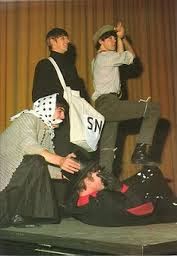
Throughout the night The Beatles would appear in between acts putting on little skits.

"The Beatles were never much for rehearsing. That never really mattered as far as songs were concerned, but the fact that they were so bad at doing the sketches was an added extra for the show- it was organised chaos but it was very funny chaos." -Tony Barrow
The Beatles spent Christmas with their families in Liverpool on a private viking aircraft provided by Brian Epstein and returned back to London on Boxing Day.


"The big trick was to get them out of the theatre before the national anthem had finished. The audience dutifully stayed, chanting "We want The Beatles,' by which time they were in their car and away'."- Tony Barrow


Right: John Lennon dressing room for The Beatles first Christmas Show


Left: Cast of the show


Another Beatles Christmas Show

The following year, 24 December, 1965 Brian Epstein promoted another Christmas Show except this time at the Hammersmith Odeon in London. It was very much like the previous year in which The Beatles would preform skits in between acts then close the show with several of their songs.
The night went as followed:

First Act:
  • The Mike Cotton Sound preforming Georgie Fame's "Yeh Yeh"
  • Michael Haslam joining the Mike Cotton Sound singing "Scarlet Ribbons"
  • The Yardbirds
  • The Beatles dressed as Antarctic Explorers searching for the Abominmal Snowman
  • Freddie and The Dreamers singing "Rip it Up", "Bachelor Boy", and "Cut Across Shorty"
Drawing by John on the back of the programme
Second Act:
  • Elkie Brooks
  • Sounds Incorporated
  • Jimmy Savile introduced The Beatles
  • The Beatles
The group once again ended the night singing;
  • Twist and Shout
  • I'm A Loser
  • Baby's in Black
  • Everybody's Trying To Be My Baby
  • Can't Buy Me Love
  • Honey Don't
  • I Feel Fine
  • She's A Woman
  • A Hard Days Night
  • Rock And Roll Music
  • Long Tall Sally
Two weeks later at a press conference in Toronto the group was asked if they were preforming in a third Christmas Show for the following year where John replied;
"Ask Mr. Christmas Epstein"
and George added,
"Mr. Epstein, may have a Mr. Epstein Christmas Show"


"Because it was new to them they didn't make a fuss. But as the run went on I think they relised it wasn't really working. They wanted to be songwriters and pop stars, they didn't want to be actors." -Barron Knights, Pete Langford.

Wednesday, December 4, 2013

"All Things Must Pass inducted into Grammy Hall of Fame

Today (December 4, 2013) George Harrison's facebook page posted the following;

"We were thrilled to learn today that The Recording Academy has announced 'All Things Must Pass' is to be inducted into the legendary GRAMMY Hall of Fame in 2014.

The GRAMMYs Hall of Fame honours both singles, and album recordings of all genres that are at least 25 years old, and which “exhibit qualitative or historical significance”. This year – the 40th anniversary of the Hall of Fame – there are to be 27 inductees, bringing the total list to 960 titles (this list is on display at The Grammy Museum at L.A. Live).

Neil Portnow (President/CEO of The Recording Academy) described these recordings as “memorable and inspiring, [they] are proudly added to our growing catalog — knowing that they have become a part of our musical, social, and cultural history.”

The newly revealed inductees will be acknowledged during the 56th annual Grammy Awards, which will air January 26, 2014, on CBS. "
 The album is being inducted along with many other albums from The Joshua Tree (U2)  to singles like B.J Thomas's single "Raindrops Keep Fallin' on my Head" and The Rolling Stones "Honky Tonk Women"  and many others!

The Beatles as a group have been nominated for 25 Grammy Awards and won 8 ( Bold on the following list) out of the 25;

1964; 

Beatles Grammy For "Best Performance By Vocal Group"
  • Record Of The Year- "I Want To Hold You Hand"
  • Best Contemporary Song- "A Hard Days Night"
  • Best New Artist
  • Best Performance by a Vocal Group- "A Hard Days Night"
1966;
  • Contemporary Rock & Roll Group Vocal Preformance- "Help!"
  • Album of the Year- Help!
  • Vocal Group Performance- "Help!"
1967;
  • Album of The Year- Revolver  
  • Song of The Year- "Michelle"
1968;
  • Album of The Year- Sgt. Pepper's Lonely Hearts Club Band
  • Best Contemporary Album- Sgt. Pepper's Lonely Hearts Club Band
  • Group Vocal Preformance- "Sgt. Pepper's Lonely Hearts Club Band"
  • Best Instrumental Arrangement Accompanying Vocalist(s)- "A Day in the Life"
1969;
  • Album of the Year- Magical Mystery Tour
  • Record of the Year- "Hey Jude"
  • Best Pop Performance by a Duo or Group with Vocals- "Hey Jude"
 1970;
  • Album of the Year- Abbey Road
  • Contemporary Vocal Group- Abbey Road
1971; 
  • Record of the Year- "Let It Be"
  • Contemporary Vocal Group- Let It Be
1996;
  • Best Historical Album- Live at the BBC
1997;
  • Best Music Video, Long Form- The Beatles Anthology
  • Best Music Video, Short Form- "Free as a Bird"
  • Best Pop Performance by a Duo or Group with Vocal- "Free as a Bird" 

George Harrison alone and after The Beatles has won a few other Grammy's such as ;
  •  Album of The Year- The Concert For Bangla Desh [1972] (Read more about the concert here ).
  •  Best Rock Performance By A Duo or Group Vocal- Traveling Wilburys Volume One [1989]
  • Best Pop Instrumental Performance- "Marwa Blues" [2003]

This coming February to honor The Beatles 50th year anniversary of being on The Ed Sullivan Show The Grammys are presenting  "The Night That Changed America: A GRAMMY Salute To The Beatles."  It will be a 2- hour showing and brodcasted on the CBS Television Network on Sunday February 9, 2014 ( the exact date The Beatles first played Ed Sullivan, read more about their performances here) from 9-10 p.m ET/PT.


Read more about the Ed Sullivan Grammy event on their website, here


Tuesday, December 3, 2013

McCartney Success 2013


If you're unfamiliar with Sir Paul McCartney's new album, NEW, read about them here  and here .

This past year, ex-Beatle, Paul McCartney, went back into the studio to start recording his first solo album in six years! It was released today (December 3, 2013) that this new album was voted the fourth album of the year by Rolling Stone magazine.

"The sound of a 71-year-old Beatle getting back in the ring. McCartney plays to his strengths: Wings-like glam rock, Little Richard howls and, yep, some remarkably Beatlesque pop tunes and George Martin-ish arrangements (thanks partly to Martin's son, Giles, who produced several tracks). "Early Days" challenges lingering misconceptions about McCartney's role in the Beatles ("I don't see how they can remember/When they weren't where it was at"). Sir Paul also engages 21st-century pop with sharp ears, bringing in young-gun producers like Paul Epworth, Mark Ronson and Ethan Johns. He even rocks a quasi-rap flow and some giddy, Gaga-style stadium chants on "Queenie Eye." As Macca understands better than almost anyone, rock & roll is fueled by a hunger for good times and an ageless exuberance.
 
In late October, right after the albums release, NEW hit #3 in Billboard charts. Not only has NEW been successful for McCartney, but Paul was also awarded the "Best Individual Achievement of the Decade" by Vegfest UK Awards.

"The accolade was presented to Paul in recognition of his continued championing of vegetarianism, such as through his work with the Meat Free Monday campaign. The award was voted for by members of the public prior to the London Vegfest which took place recently at Kensington Olympia." -Paul McCartney via Facebook
Congrats Paul!

Rubber Soul

Recording Dates: October 12, 1965- November 15, 1965
Total Album Time: 34:50
Producer: George Martin
Engineer: Norman Smith
Released: December 3, 1965 (UK)
                 December 6, 1965 (US)
John Lennon:
vocals, electric guitar, acoustic guitar, piano, Vox Continental organ, tambourine
Paul McCartney: vocals, bass guitar, electric guitar, acoustic guitar, piano
George Harrison: vocals, electric guitar, acoustic guitar, sitar, tambourine
Ringo Starr: vocals, drums, cowbell, tambourine, maracas, percussion, bells, Hammond organ
George Martin: piano, harmonium, tambourine
Mal Evans: Hammond organ

Rubber Soul was The Beatles sixth released album in the UK and eleventh US long-player. It was, as Paul once called it, the 'Grown up album'. In the early days the group was highly influenced by American singers and songwriters like Elvis Presley, Chuck Berry, and Buddy Holly. The whole American rhythm-and-blues but now they were being influenced, or becoming more aware of Motown and black music  and then into apparent classical and modern music as George Martin said.
"By the time of Rubber Soul they were ready for new musical directions." -George Martin
Beatles producer, George Martin, has also spoken about recording with The Beatles during the Rubber Soul time as the group always searching for a new sound and always willing to try any new instruments (which could be factored in with George Harrison's interest in the sitar) even if they didn't know how to play it or anything about them. 

Drugs:
Throughout their musical careers The Beatles were always being introduced to drugs,
"It was like pills influenced us in Hamburg, drink influenced us in so and so, I mean, we weren't all stoned making Rubber Soul, because in those days we couldn't work on pot. We never recorded under acid." -John Lennon (1972)
John even says in that Rubber Soul was the pot album and Revolver was the acid. Ringo even said that,
"There was a lot of experimentation on Rubber Soul, influenced, I think by the substances."
He continues to say that because of these substances recording and things would take longer. George even reflected saying it made them feel ill. It's no secret that the group used drugs, especially pot after being introduced to it by Bob Dylan in 1964 (Read more Bob Dylan and The Beatles first experience with marijuana here).  George Harrison describes one recording session as,
"Mal and Neil would sit in Studio No. 2 behind the sound baffles while we were working, rolling them up and smoking. You can hear on one of the tapes from the sessions a song starts and John goes, 'Hang on. 'ang on...' and Paul starts filling in for him. Then John comes back; 'Ahhhhh. OK, OK.' And by the time the engineers have rewound the tape you're thing, 'I'll just go and have another hit.'"
"When we did take too many substances, the music was shit, absolute shit. At the time we'd think it was great, but when we came to record the next day we'd all look at each other and say, 'we'll have to do that again..'"- Ringo Starr
Songs:
  1. Drive My Car;
The album starts with "Drive My Car" a song that can be interrupted in many different ways. As Paul says, "What's is it? What's he doing? Is he offering a job as a chauffeur, or what?" McCartney even says that the song was one of the 'stickiest' songs he ever wrote. It started with this one phrase, "You can buy me golden rings" and says he struggled with the song for hours, too long. Suddenly it hit McCartney and Lennon, "Baby, you can drive my car!" and that's how the song came to be. They were glad with the fact of how ambitious the song was and is and how many different scenarios. 
     
       2. Norwegian Wood (This Bird Has Flown);

John had written "Norwegian Wood" about an affair he was having and said he was very 'careful' and 'paranoid' about writing it and the affair itself because he didn't want his first wife, Cynthia Powell, to find out (Read more about Cynthia here). Saying he was always having some kind of affair and this was a way to be sophisticated about writing about the affairs. During this time George Harrison had already been introduced to the sitar, first really seeing it when filming "Help!" in a restaurant scene where he first started messing around with the instrument.The group went through many versions of the song because it wasn't coming out like John wanted and he was getting angry.
"It was such a mind-blower that we had this strange instrument on the record. We were all open to anything when George introduced the sitar; you could walk in with an elephant, as long as it was going to make a musical note. Anything was viable. Our whole attitude was changing. We'd grown up a little, I think." -Ringo Starr
         3. Nowhere Man

Paul McCartney recalls the sang as a song written by John after coming in from a big night and not going to bed till about five in the morning. John had come to Paul telling him that he had just started a song the previous night.
"It turned out later that it was about me." -Paul McCartney
Although Paul says it was written about him John really says that the song was inspired by himself,
"I was just sitting, trying to think, and I thought of myself sitting there, doing nothing and going nowhere," he continues, "I thought of myself as a Nowhere Man sitting in this Nowhere Land" -John Lennon (1967)
It was one of those songs, like "Across The Universe" on Let It Be, that came all at once, music, words, the whole thing. 

          4.Think For Yourself

          5. The Word

          6. Michelle 
A song that started with John and Paul walking and Paul humming the first few bars with the words  then turning to Lennon for help.  Where John remembers how he was listening to Nina Simone and a refrain from "I Put A Spell On You" that went, " I love you, I love you, I Love you." which became the middle eight: "I Love You, I love you, I l-o-oove you" in "Michelle".
When it was released Paul describes it as a 'walking on pins and needles', it was different then what they were playing and that's what makes it unique. McCartney compares it to Cliff Richards "Living Doll" and how when it first was released it was so out of left-field.
        
            7. What Goes On
The only song credited to Lennon-McCartney-Starr

            8. Girl
"'Girl' is real. There is no such thing as the girl; she was a dream, but the words are all right, it wasn't just a song, and it was about that girl- that turned out to be Yoko, in the end- the one that a lot of us were looking for."- John Lennon
In the same interview (from 1970) John says that he was trying to say something about Christianity. Saying that it was heavily on the church but was never picked up. It's about having to be tortured to get to heaven, the Catholic and Christian concept. "Be tortured and then it'll be all right.; which seems to be true." John didn't believe in that, the whole having to be tortured to be accepted into  anything.


            9. I'm Looking Through You
Just like other Beatles songs during this time, "You Won't See Me" and "We Can Work It Out"  this song was based off of a fight Paul had with his current girlfriend, Jane Asher.
"As is one's wont in relationships, you will from time to time argue or not see eye to eye on things, and a couple of the songs around this period were that kind of thing. This one I remember particularly as me being disillusioned over her commitment. She went down to the Bristol Old Vic quite a lot around this time. Suffice to say that this one was probably related to that romantic episode and I was seeing through her façade. And realising that it wasn't quite all that it seemed. I would write it out in a song and then I've got rid of the emotion. I don't hold grudges so that gets rid of that little bit of emotional baggage. I remember specifically this one being about that, getting rid of some emotional baggage. 'I'm looking through you, and you're not there!'"- Paul McCartney
            10. In My Life
One of the greatest songs John Lennon has ever written. George Martin even says it's one of his favorites because its 'so much John'. John even calls it his 'first real song'.
"It was the first song that i wrote that was really, consciously, about my life."
The song came about when John released his first book, In His Own Write when a journalist asked ' Why don't you put some of the way you write in the book in the songs? or Why don't you put something about your childhood into your songs?'  The song goes through a bus route from his aunt and uncles home at 251 Menlove Avenue to the town.
"'In My Life' a remembrance of friends and lovers of the past."- John Lennon
            11. Wait

            12. If I Needed Someone
Up to this point the songwriting was mostly the Lennon- McCartney duo. George Harrison had been writing since With The Beatles and when he did start writing he had to suddenly just jump into it saying, "John and Paul had been writing since they were three years old."
"I had to come from nowhere and start writing and have something with at least enough quality to put on the record."- George Harrison
           13. Run For Your Life
 A song that John never liked because it was a song that was 'just knocked off'. Although it was always one of George's favorites.
John said that the song was inspired by "Baby Let's Play House" by Elvis. There was a line that went " I'd rather see you dead, little girl, than to be with another man." The rest of the song was based around that line.

Charts and Release: 
The album was released on December 3, 1965 in the UK and entered the UK charts on December 11 and soon replaced Help! on December 25. The album was number one for nine weeks straight and remained for another forty-two weeks.

The LP was released three days  after the UK release and joined the US charts on the same day as the UK. It stayed in the charts for fifty-nine weeks. Even the following year on January 8, 1966 spent six weeks at number one.

Cover: 

Like With The Beatles to Rubber Soul all of the album covers had been taken by Robert Freeman. The photo session was taken at John's Weybridge home. The Rubber Soul album cover has a unique feature caused by a card that the picture as projecting fell backwards and stretched The Beatles faces.
"I liked the way we got out faces to be longer on the album cover, we lost the 'little innocents' tag, the naivety and Rubber Soul was the first one where we were fully-fledged potheads."- George Harrison

Fun Facts:
  • It sold 1.2 million copies in nine days of it's release in the US
  •  There were two different stereo version released in America. "Dexter stereo" and "East Coast" Version. 
  • The US released added a double-tracked vocals on The Word by John Lennon. 
  • "Golden Rings" from the original 'Drive My Car' became "Beep! Beep! Beep! Beep! Yeah!"
  • Paul says that when it came to song writing, the melody, "In My Life" was the only song that John and him really disagreed on.
  • In "Girl" The Beatles were singing "Tit-tit-tit-tit' In the background and nobody noticed. 
  • Rubber Soul was George Harrison's favorite album 
"A lot was changing- our attitudes, our lives- at this time, and the Rubber Soul session were the start of the building- up to the end, in away we were doing great stuff and the results were great." -Ringo Starr